The Thinking Pod Innovations Ltd.
Ingenuity Centre
University of Nottingham Innovation Park
Triumph Road
Nottingham
NG7 2TU

Infineon Matrix Drive Evaluation Kit
OVERVIEW
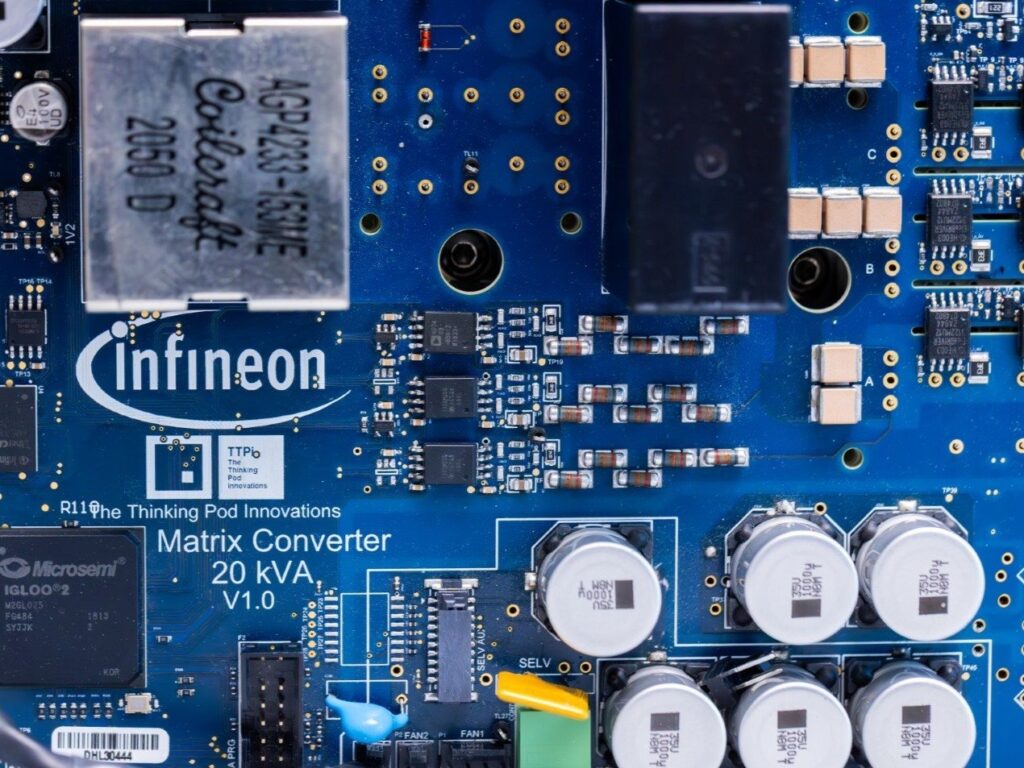
The Matrix Converter is an industrial motor drive reference design based on the three phase to three phase matrix converter drive topology. The project delivered three fully functional prototypes to Infineon R&D.
This reference design demonstrates the Matrix Converter Drive concept – a joint development between Infineon Technologies and Thinking Pod Innovations (TTPi). Within a very short development timeline, the team achieved the design and implementation of a single-printed circuit board (PCB) converter integrating the controller, driver circuitry, three-phase AC/AC Matrix Converter, protection circuits, and the main switched-mode power supply (SMPS) for on-board power management.
The delivery package also included a complete microcontroller unit/field-programmable gate array (MCU/FPGA) firmware suite, enabling users to fully leverage the Matrix Converter’s AC/AC power stage features for motor-drive applications. In addition, custom bi-directional switch modules utilizing 1.2 kV SiC technology and embedded current and temperature measurement were developed by Infineon to support this design.
CLIENTS/PARTNERS
- The Thinking Pod Innovations (TTPi)
- Infineon Technologies
OUR APPROACH
The Matrix Converter AC-AC project reimagined industrial motor drives by eliminating the traditional DC link stage and implementing a direct AC-to-AC conversion topology within a compact, single-board architecture. Achieving this integration demanded a multidisciplinary engineering strategy spanning power electronics, control algorithms, firmware development, signal integrity, and thermal design.
Our approach centred on a highly integrated, modular PCB layout that combined the control unit, driver stages, and power converter within a unified platform. This architecture minimized parasitic effects, improved switching performance, and optimized thermal distribution – critical for achieving high efficiency and reliability under industrial load conditions.
Iterative prototyping and validation accelerated design maturity, ensuring stable operation, robust protection mechanisms, and seamless firmware integration with the FPGA/MCU control environment.
The compact reference design demonstrates the Matrix Drive’s advantages in efficiency, power density, and control precision for next-generation motor-drive applications.
CAPABILITIES APPLIED
Ultra efficient power conversion, Advanced digital control, Exploitation of ultra-high-speed switching devices & conventional devices, AC-AC, Advanced power converter modulation & firmware design
OUTCOME & IMPACT
The Matrix Converter AC-AC reference design delivers a breakthrough in industrial drive technology by demonstrating a fully integrated, and DC-link–free AC/AC conversion system which is bi-directional in nature and exhibits very low harmonic disturbances to the grid. By removing the intermediate DC stage, the system achieves a significant reduction in component count, system volume, and conversion losses, setting a new benchmark for compact, efficient motor-drive architectures.
Field evaluations showed marked improvements in efficiency, validating the Matrix topology as a viable next-generation alternative to traditional voltage-source inverter (VSI) drives.
The project’s success also accelerated SiC technology adoption, with Infineon’s 1.2 kV bi-directional SiC switch modules demonstrating superior performance and scalability for future high-density power systems. The accompanying firmware and FPGA control framework enabled dynamic control, fault protection, and ease of customization for diverse industrial applications.
Beyond its technical achievements, the Matrix Converter AC-AC initiative fostered cross-disciplinary collaboration and engineering skill development, bridging advanced research and industrial realization.
APPLICATIONS BEYOND THIS PROJECT
The Matrix Converter AC-AC architecture has broad applicability across industrial automation, particularly in sectors such as Heating, ventilation and air-conditioning (HVAC) systems, and renewable energy infrastructure, where compactness, bidirectional power flow, and high efficiency are critical. Its elimination of the DC link makes it especially advantageous in space-constrained environments and applications requiring fast dynamic response or regenerative braking capability.
As a reference design, the Matrix Converter AC-AC serves not only as a proof of concept but also as a launchpad for next-generation power electronics, enabling more sustainable, compact, and intelligent energy conversion solutions across multiple industries.