The Thinking Pod Innovations Ltd.
Ingenuity Centre
University of Nottingham Innovation Park
Triumph Road
Nottingham
NG7 2TU

National Grid
OVERVIEW
To meet government net zero targets, the electricity system must integrate far greater volumes of renewable energy. However, when multiple renewable sources connect to the grid, they can create challenges for fundamental network stability. The aim of this work with National Grid ESO and the University of Nottingham was to create a flexible, grid-connected platform that allows renewable energy generation and storage systems to deliver stable, reliable power to the network. The project demonstrated a more stable and scalable alternative to conventional integration methods, directly supporting the transition to a renewables-dominated grid.
CLIENTS/PARTNERS
- National Grid ESO had been investigating Virtual Synchronous Machine (VSM) technology as a potential solution to the risk of network instability.
- University of Nottingham has developed new VSM grid-control algorithms which reduce the risk of network instability.
- TTPi (The Thinking Pod innovations) used expertise in advanced converter architectures, control integration, and robust hardware design to create a power converter to test and validate the university’s new grid-control algorithms.
OUR APPROACH
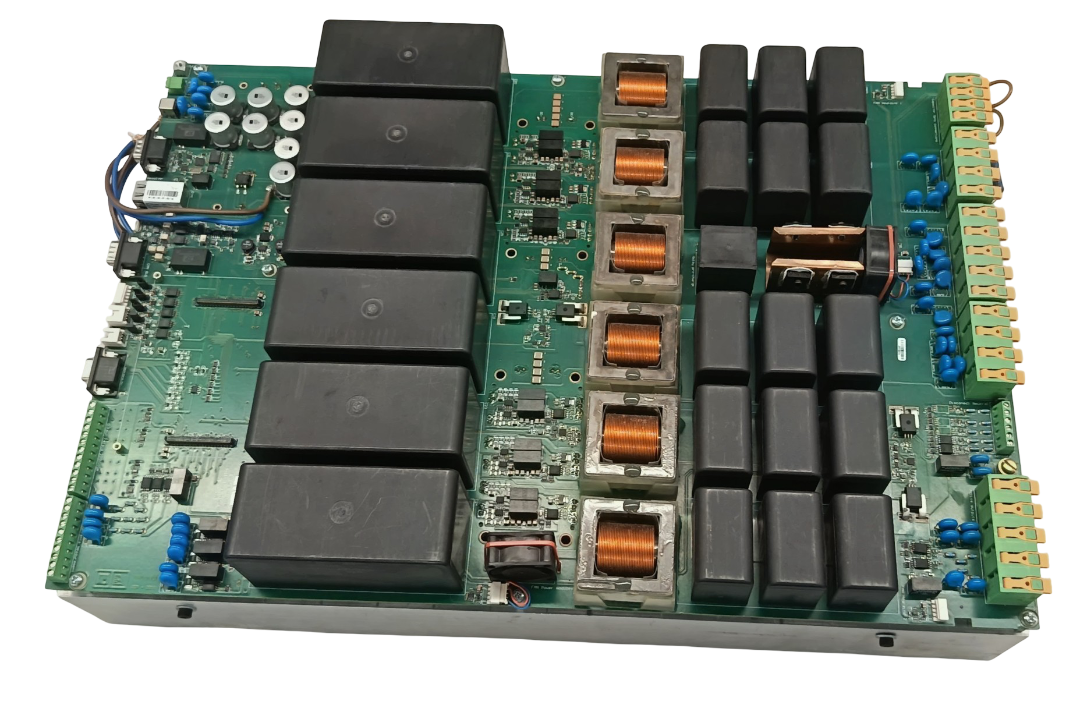
TTPi was commissioned to design and build the hardware platform to validate a variety of the grid-control algorithms and more specifically VSM, developed by the University of Nottingham. Our role centred on creating a versatile power controller capable of interfacing with multiple sources – from renewable generators to storage systems – while delivering precise three-phase grid connection.
We engineered a 50 kW three-phase power converter, built with modularity in mind, to serve as a testbed for new grid-control algorithms. The converter was designed for high fidelity, ensuring accurate emulation of synchronous machine behaviour and reliable validation of various control schemes.
TTPi expertise provided National Grid ESO with a platform that bridged the gap between simulation and real-world validation.
CAPABILITIES APPLIED
Ultra efficient power conversion, Advanced digital control, Grid Integration, Exploitation of ultra-high-speed switching devices & conventional devices, DC AC, AC AC, Grid integration, Advanced Power Converter Modulation & Firmware Design
OUTCOME & IMPACT
The project successfully delivered a 50kW, three phase converter that enabled National Grid ESO and the University of Nottingham to validate novel grid-stability algorithms. The prototype demonstrated how this architecture can provide a more stable and scalable alternative to conventional synchronisation methods, directly supporting the transition to a renewables-dominated grid.
By validating these algorithms in hardware, the project took a significant step toward enabling grid operators to manage higher penetrations of renewable energy while maintaining stability of supply.
APPLICATIONS BEYOND THIS PROJECT
The prototype platform developed in this project has wide-reaching applications across renewable energy integration and storage systems, including:
- Solar Inverters: enabling stable, grid-synchronised operation of large-scale photovoltaic systems.
- Grid connected battery storage
- Renewable generators, including wind and hydro.